Solutions
21/08/2019

Weixin Chong & Pauline Emond
Open Studio 21-28 August, 2-6pm
Chateau Nour
13 Square Albert 1er
1070 Brussels
溶质
róng zhì / Solutions
An open studio exhibition
EN : While Weixin Chong creates installations and images, often with digital prints and textiles, Pauline Emond practices engraving, sculpture, and drawing. The landscape they develop together is made of solutions and dissolutions, dialogues between organic and mechanic, forming vs non-forming, decorative flowers prepared for consumption and precariously preserved. Orchidelirium is a symbol of exotic beauty, plants with monstrous proportions, intense blue Bunga Telang. Meanwhile, the two artists question what are made out computers. Reduced to powders and fluids, their existence is like a spell. The two artists intend to undo computers, infiltrate their internal and organic existence.
FR : Alors que Weixin Chong réalise des installations et images, souvent avec des impressions digitales et textiles, Pauline Emond pratique la gravure, sculpture et le dessin. Le paysage qu’elles aménagent ensemble est fait de solutions et de dissolutions, de dialogues entre organique et mécanique, formes existantes ou non, des fleurs destinées à la décoration préparées pour la consommation et conservées de manière précaire. L’orchidelirium est un symbole de la beauté exotique, de plantes aux proportions monstrueuses, bleu intense de Bunga Telang. Parallèlement, les deux artistes questionnent de quoi sont faits nos ordinateurs. Réduits à des poudres et des fluides, leur existence est comme un sort. Les deux artistes veulent défaire les ordinateurs, infiltrer leur existence interne et organique.
NL : Terwijl Weixin Chong installaties en afbeeldingen maakt, vaak met digitaal drukwerk en textiel, beoefent Pauline Emond het graveren, beeldhouwen en tekenen. Het landschap dat ze samen ontwikkelen, bestaat uit oplossingen en ontbindingen, uit dialogen tussen organisch en mechanisch, uit bestaande vormen of net niet, uit bloemen bedoeld voor decoratie en klaar voor consumptie en conservatie op precaire wijze. Het orchidelirium is een symbool van exotische schoonheid, van planten met monsterlijke proporties, een intens blauw van Bunga Telang. Tegelijkertijd vragen de kunstenaars zich af waar onze computers uit bestaan. Herleid tot poeder en vloeistoffen, is hun bestaan als een soort vloek. De twee kunstenaars willen computers ongedaan maken, infiltreren in hun interne en organische bestaan.
With the support of National Art Council Singapore
New space : Chateau NOUR
23/04/2019
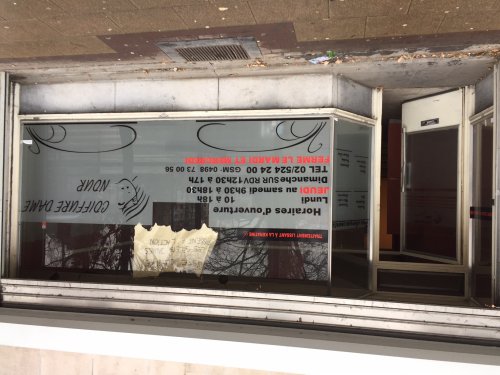
On 23 April, Komplot opened Chateau Nour, a new exhibition and residency space with Mosso, Clovis XV, SUPERDEALS and Rectangle.
13 Square Albert 1er 1070 Brussels
Notre objectif, avec l’ouverture d’un nouvel espace intérieur et extérieur, dans l'ancien salon de coiffure NOUR et jardin Albert, est de stimuler les collaborations entre Clovis XV, Komplot, Mosso, Rectangle, SUPER DEALS et d’autres associations, groupes et personnes. Sur la base d'un programme d’ateliers et résidences, nous créons un réseau dans lequel développement local et participation vont de pair avec des formes expérimentales de créativité.
——
Our goal, with the opening of a new interior and exterior space, in the former NOUR hair salon and Albert garden, is to stimulate collaborations between Clovis XV, Komplot, Mosso, Rectangle, SUPER DEALS and other associations, groups and people. On the basis of a program of workshops and residences, we create a network in which local development and participation go hand in hand with experimental forms of creativity.
————
Ons doel, met de opening van een nieuwe binnen- en buitenruimte, in de voormalige kapsalon NOUR en Albert tuin, is om samenwerkingen tussen Clovis XV, Komplot, Mosso, Rectangle, SUPER DEALS en andere verenigingen te stimuleren, groepen en mensen. Op basis van een programma van workshops en residenties creëren we een netwerk waarin lokale ontwikkeling en participatie hand in hand gaan met experimentele vormen van creativiteit.
ARCHIVES
30/11/-0001
